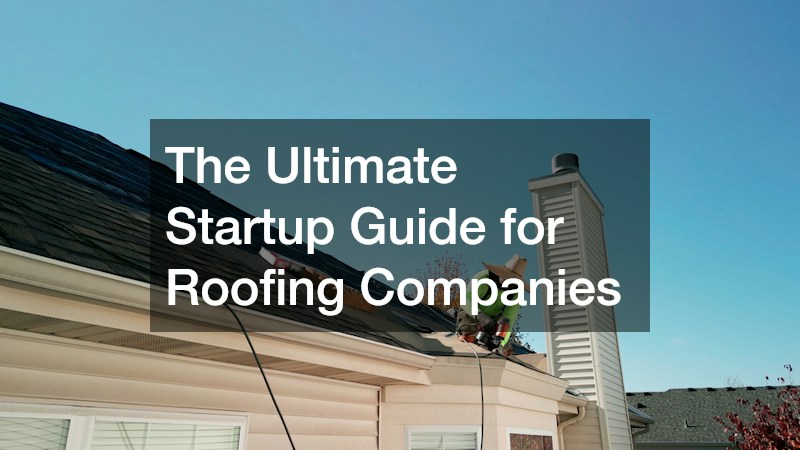
The roofing industry represents one of the most resilient, lucrative, and essential sectors in the skilled trades. Whether driven by routine architectural aging, severe weather events, or commercial development, the constant demand for durable shelter guarantees a steady flow of high-ticket opportunities. For an ambitious entrepreneur or experienced trade professional, launching an independent enterprise offers a direct path to financial independence and multi-million-dollar growth.
However, moving from a skilled trade professional or lead crew manager to the chief executive of a business requires a major mental and operational pivot. Technical trade knowledge alone is not enough to guarantee long-term survival. The trade landscape is littered with short-lived companies that failed not from poor craftsmanship, but from cash flow bottlenecks, inaccurate job pricing, disastrous safety liabilities, or poor customer acquisition strategies.
Establishing Your Legal Foundation, Licensing, and Risk Protection
Before your crews step onto a roof or unhook a ladder, you must establish a legal business structure that isolates your personal assets from commercial liabilities. Operating as a sole proprietorship is a dangerous mistake in high-hazard trades; a single job site injury or structural leak claim could expose your personal savings and property to catastrophic lawsuits.
Consult with a business attorney or certified public accountant to register an appropriate legal entity, such as a Limited Liability Company (LLC) or an S-Corporation. An S-Corporation structure often provides substantial self-employment tax benefits as your net revenue grows, while an LLC delivers simple administrative overhead and strong personal liability protection. Once registered, obtain your Federal Employer Identification Number (EIN) and open dedicated business banking accounts to keep personal and corporate finances completely separate.
Navigating trade licensing requirements is your next critical step. Licensing regulations vary significantly by state and municipality, ranging from basic business registration to rigorous master trade exams, proven field experience requirements, and verified financial credit checks.
Partnering with an experienced, certified roofing contractor mentor or trade attorney during your startup phase helps ensure your customer contracts, sub-contracts, and liability disclosures comply fully with local consumer protection laws. Your written customer proposals must include clear scopes of work, explicit material specifications, payment draw schedules, cancellation clauses, and state-mandated right-to-cancel notices.
Insurance is your primary defense against sudden operational failure. Height work carries inherent physical and financial risks, making comprehensive insurance coverage non-negotiable. At a minimum, your policy portfolio must include Commercial General Liability insurance with limits adequate for structural work, Inland Marine floaters to protect expensive tools and equipment in transit, and commercial auto policies for your truck fleet.
Mandatory Workers’ Compensation insurance must be secured for every field employee. Attempting to classify daily field labor as independent 1099 contractors to bypass Workers’ Compensation is an illegal practice that invites severe government penalties and leaves your business exposed to massive medical injury claims. Registering with municipal trade boards as a fully licensed roofer confirms your eligibility to pull permits, bid on municipal projects, and participate in high-volume storm restoration work.
-
Register a protective corporate structure: Establish an LLC or S-Corporation to shield personal assets and optimize corporate tax liabilities.
-
Secure state and municipal trade licenses: Complete all required exams, background checks, and fee filings to pull permits legally.
Defining Services, Specializations, and Technical Offerings
A successful startup must define its core service portfolio based on local market demand, climate requirements, and neighborhood demographic profiles. Trying to be everything to everyone on day one can dilute your marketing focus and strain your crew’s technical capabilities.
Begin by evaluating regional architectural trends and weather risks. In regions prone to severe summer hail and windstorms, building a business model around residential storm restoration, insurance claim handling, and rapid emergency tarping provides high-volume, high-margin work. In areas with steep-slope residential housing, focusing on premium architectural asphalt shingles, standing seam metal, or synthetic slate establishes your brand in high-end markets.
Standardize your operational workflows for core residential services. Whether executing complete tear-offs down to the roof deck or installing new underlayment systems, documented scopes of work ensure consistent installation quality. Every residential project must incorporate proper attic ventilation calculations, drip edge installation, ice and water shield barriers in valleys and eaves, and compliant flashing around chimneys and pipe boots.
Severe weather events create immediate demand for fast, reliable intervention. Establishing dedicated, rapid-response field units equipped to handle high-margin emergency roof repairs allows you to capture high-intent leads during storm events while building relationships with homeowners who will eventually need full replacements.
Your diagnostic procedures must clearly differentiate between localized maintenance and full structural replacement. Training your sales representatives to conduct thorough interior attic inspections alongside exterior roof audits ensures you provide accurate recommendations. Knowing when a structure can be safely repaired versus when it requires a complete structural reroof protects your reputation and prevents placing new materials over damaged, rotted decking.
-
Focus your initial service portfolio: Target specific high-demand residential materials based on regional climate needs and demographic profiles.
-
Standardize installation scopes: Document technical guidelines for underlayment, valley protection, flashing, and attic ventilation.
Mastering Job Costing, Estimating, and Financial Management
Inaccurate estimating is the quickest path to bankruptcy in the trade sector. Many novice owners make the fatal mistake of setting their prices based on what local competitors charge or relying on visual guesswork. If your competitors don’t understand their true operating overhead, matching their pricing simply guarantees you will lose money together.
To establish profitable pricing, you must calculate your exact “break-even square-foot rate.” A standard “square” in roofing equals 100 square feet of surface area. Calculate your direct labor costs (including payroll taxes and Workers’ Comp premiums), direct material costs (shingles, underlayment, nails, flashing, ridge vents), waste factors (typically 10% to 15%), and disposal/dumpster fees.
To this direct cost, add your fixed daily business overhead—office rent, truck payments, marketing, insurance, software, and administrative salaries—divided by your total annual installation capacity. Only after covering all direct and overhead costs do you apply your target net profit margin (typically 15% to 25%).
Modern technology has transformed the estimating process. Utilizing satellite and aerial measurement software allows you to generate precise, multi-angle roof diagrams, slope calculations, and square footage measurements in minutes without stepping onto a ladder during the initial sales call. This speeds up estimate delivery and protects your sales team from unnecessary fall hazards.
Managing cash flow requires strict customer payment structures. Never finance a customer’s project out of your own pocket. Implement a structured, tiered payment schedule: require a 30% deposit upon contract signing to secure scheduling, 40% upon material delivery to the job site, and the remaining 30% balance immediately upon final project completion and joint walkthrough inspection.
Differentiate your sales presentations from low-cost competitors by positioning your business as a quality roofer committed to long-term reliability. Offer robust, written workmanship warranties alongside manufacturer material guarantees. Aligning with major material manufacturers to earn certified contractor status allows you to offer extended system warranties that budget competitors cannot match.
-
Calculate your true break-even rate per square: Factor direct labor, materials, waste, dump fees, and fixed business overhead into every quote.
-
Leverage aerial measurement technology: Use satellite estimation software to generate fast, accurate roof measurements and slope profiles.
Expanding into Commercial Roofing and B2B Contracts
While residential work provides quick sales cycles and steady cash flow, expanding into commercial and industrial sectors unlocks high-ticket contract values and predictable, recurring maintenance revenue. Commercial projects—including retail centers, warehouses, office parks, and multi-family complexes—require specialized technical expertise and larger operational capacity.
Transitioning into the commercial market requires mastering low-slope and flat-roof membrane systems. Your team must gain technical proficiency in installing, repairing, and maintaining Thermoplastic Polyolefin (TPO), Ethylene Propylene Diene Monomer (EPDM), Polyvinyl Chloride (PVC), and modified bitumen systems. Earning technical certifications from top commercial membrane manufacturers allows you to bid on large commercial projects and issue long-term No Dollar Limit (NDL) manufacturer warranties.
Target commercial property managers, Homeowners Associations (HOAs), and real estate development firms with proactive maintenance programs. Commercial property owners prioritize risk mitigation and predictable budgeting over low upfront costs. Offering annual or semi-annual roof inspection contracts allows you to catch minor membrane punctures, open seams, and clogged roof drains before they cause interior water damage.
Establishing your company as a capable commercial roofer requires investing in specialized commercial safety equipment, high-capacity material handling machinery, and specialized safety training. Commercial job sites are strictly monitored for OSHA compliance, requiring dedicated safety plans, perimeter warning lines, safety monitor protocols, and personal fall arrest systems.
Commercial diagnostic tools can turn routine inspections into lucrative service contracts. Utilizing thermal imaging cameras during dry weather allows your inspectors to identify subsurface moisture trapped beneath flat roof membranes. Presenting property managers with detailed thermal reports highlighting exact moisture intrusion zones positions your firm as an expert in commercial roof repair, securing high-margin repair and restoration work without competitive bidding.
-
Master flat-roof membrane systems: Build technical team capabilities in TPO, EPDM, PVC, and liquid-applied coating installations.
-
Target commercial property managers: Pitch annual inspection and preventive maintenance programs to build recurring corporate revenue.
Building a Local Lead Generation Engine and Marketing Strategy
Relying solely on word-of-mouth referrals is a dangerous long-term strategy for a growing business. To maintain steady crew utilization and consistent monthly revenue, you must build a multi-channel lead generation engine that delivers high-intent leads year-round. Promoting special deals on specific specific services such as roof installations is a strong tactic to draw in new customers.
Your digital presence serves as your primary sales storefront. Optimize your Google Business Profile with verified job-site photos, accurate service boundaries, and consistent customer reviews. Local map listings are the highest-converting digital real estate for home service contractors; dominating local map searches ensures homeowners finding you during emergency leaks contact your team first.
Combine digital visibility with high-impact hyper-local field marketing. Whenever your crews are working on a residential project, transform the job site into a marketing hub. Place bold, high-visibility yard signs near the street (with homeowner permission), wrap all company trucks with clean, professional branding, and deploy targeted door-hanger campaigns to the 50 surrounding homes highlighting the work being done in their neighborhood.
Build a modern, conversion-optimized website that features real customer testimonials, clear service descriptions, interactive pricing calculators, and flexible financing options. Offering customer financing through third-party lenders removes price friction, allowing homeowners to select full roof replacements over temporary patches.
Establish strong B2B referral networks within your local community. Build strategic relationships with insurance adjusters, real estate agents, home inspectors, and general contractors who do not perform roofing work. Positioning your company in trade directories as a premier local commercial roofer ensures business owners and real estate professionals turn to your firm for property transaction inspections and commercial repairs.
-
Dominate local map searches: Optimize your Google Business Profile to capture high-intent local search traffic.
-
Execute hyper-local job-site marketing: Deploy branded yard signs, professional vehicle wraps, and neighbor door-hangers around active sites.
Recruiting, Safety Protocols, and Operational Systems
As your business grows, your primary role shifts from managing jobs to managing people and systems. The ultimate ceiling to scaling any trade business is human capital. Building a reliable, professional workforce requires creating a strong company culture, offering competitive compensation, and enforcing strict safety protocols.
Workplace safety must be embedded into your corporate culture from day one. Fall protection violations consistently top OSHA’s list of most frequently cited trade hazards, carrying massive regulatory fines and life-altering injury risks. Enforce a mandatory 100% tie-off policy for all work above six feet. Conduct weekly tailgate safety meetings, inspect harnesses and lanyards daily, and immediately terminate workers who bypass mandatory safety lines.
Recruiting top-tier talent in a competitive market requires offering clear career progression. Build a structured apprenticeship and training pipeline where motivated ground crew members can advance to lead installers, crew foremen, and project estimators. Offering competitive hourly wages, performance bonuses, health benefits, and paid time off attracts career-minded professionals who take pride in their work.
Systemize your daily field operations through cloud-based contractor management software. Modern platforms unify customer relationship management (CRM), job scheduling, aerial estimation, material ordering, field photo documentation, crew dispatching, and invoicing into a single digital workflow. Require foremen to upload time-stamped job-site photos at key installation phases—deck inspection, underlayment, flashing, and final cleanup—to verify installation quality remotely.
Superior customer service and site cleanliness are powerful brand differentiators. Out-execute unorganized local roofing companies by enforcing strict job-site etiquette: mandate property protection tarps over landscaping and decks, enforce magnetic nail sweeps across driveways and lawns, and conduct a final joint walkthrough with the property owner before collecting final payment.
-
Enforce zero-tolerance fall protection policies: Require 100% tie-off compliance, daily harness checks, and weekly safety briefings.
-
Create clear career growth pathways: Build structured training pipelines to advance ground workers into foremen and estimators.
Commit to making the strategic pivot today. Move beyond the daily grind of field labor and focus your energy on building repeatable operational systems, mentoring your team, and serving your community. As you put structured processes and dedicated personnel in place, you will build a highly profitable, respected company built to thrive for generations to come.
The roofing industry represents one of the most resilient, lucrative, and essential sectors in the skilled trades. Whether driven by routine architectural aging, severe weather events, or commercial development, the constant demand for durable shelter guarantees a steady flow of high-ticket opportunities. For an ambitious entrepreneur or experienced trade professional, launching an independent enterprise offers a direct path to financial independence and multi-million-dollar growth.
However, moving from a skilled trade professional or lead crew manager to the chief executive of a business requires a major mental and operational pivot. Technical trade knowledge alone is not enough to guarantee long-term survival. The trade landscape is littered with short-lived companies that failed not from poor craftsmanship, but from cash flow bottlenecks, inaccurate job pricing, disastrous safety liabilities, or poor customer acquisition strategies.
Establishing Your Legal Foundation, Licensing, and Risk Protection

Before your crews step onto a roof or unhook a ladder, you must establish a legal business structure that isolates your personal assets from commercial liabilities. Operating as a sole proprietorship is a dangerous mistake in high-hazard trades; a single job site injury or structural leak claim could expose your personal savings and property to catastrophic lawsuits.
Consult with a business attorney or certified public accountant to register an appropriate legal entity, such as a Limited Liability Company (LLC) or an S-Corporation. An S-Corporation structure often provides substantial self-employment tax benefits as your net revenue grows, while an LLC delivers simple administrative overhead and strong personal liability protection. Once registered, obtain your Federal Employer Identification Number (EIN) and open dedicated business banking accounts to keep personal and corporate finances completely separate.
Navigating trade licensing requirements is your next critical step. Licensing regulations vary significantly by state and municipality, ranging from basic business registration to rigorous master trade exams, proven field experience requirements, and verified financial credit checks.
Partnering with an experienced, certified roofing contractor mentor or trade attorney during your startup phase helps ensure your customer contracts, sub-contracts, and liability disclosures comply fully with local consumer protection laws. Your written customer proposals must include clear scopes of work, explicit material specifications, payment draw schedules, cancellation clauses, and state-mandated right-to-cancel notices.
Insurance is your primary defense against sudden operational failure. Height work carries inherent physical and financial risks, making comprehensive insurance coverage non-negotiable. At a minimum, your policy portfolio must include Commercial General Liability insurance with limits adequate for structural work, Inland Marine floaters to protect expensive tools and equipment in transit, and commercial auto policies for your truck fleet.
Mandatory Workers’ Compensation insurance must be secured for every field employee. Attempting to classify daily field labor as independent 1099 contractors to bypass Workers’ Compensation is an illegal practice that invites severe government penalties and leaves your business exposed to massive medical injury claims. Registering with municipal trade boards as a fully licensed roofer confirms your eligibility to pull permits, bid on municipal projects, and participate in high-volume storm restoration work.
- Register a protective corporate structure: Establish an LLC or S-Corporation to shield personal assets and optimize corporate tax liabilities.
- Secure state and municipal trade licenses: Complete all required exams, background checks, and fee filings to pull permits legally.
Defining Services, Specializations, and Technical Offerings
A successful startup must define its core service portfolio based on local market demand, climate requirements, and neighborhood demographic profiles. Trying to be everything to everyone on day one can dilute your marketing focus and strain your crew’s technical capabilities.
Begin by evaluating regional architectural trends and weather risks. In regions prone to severe summer hail and windstorms, building a business model around residential storm restoration, insurance claim handling, and rapid emergency tarping provides high-volume, high-margin work. In areas with steep-slope residential housing, focusing on premium architectural asphalt shingles, standing seam metal, or synthetic slate establishes your brand in high-end markets.
Standardize your operational workflows for core residential services. Whether executing complete tear-offs down to the roof deck or installing new underlayment systems, documented scopes of work ensure consistent installation quality. Every residential project must incorporate proper attic ventilation calculations, drip edge installation, ice and water shield barriers in valleys and eaves, and compliant flashing around chimneys and pipe boots.
Severe weather events create immediate demand for fast, reliable intervention. Establishing dedicated, rapid-response field units equipped to handle high-margin emergency roof repairs allows you to capture high-intent leads during storm events while building relationships with homeowners who will eventually need full replacements.
Your diagnostic procedures must clearly differentiate between localized maintenance and full structural replacement. Training your sales representatives to conduct thorough interior attic inspections alongside exterior roof audits ensures you provide accurate recommendations. Knowing when a structure can be safely repaired versus when it requires a complete structural reroof protects your reputation and prevents placing new materials over damaged, rotted decking.
- Focus your initial service portfolio: Target specific high-demand residential materials based on regional climate needs and demographic profiles.
- Standardize installation scopes: Document technical guidelines for underlayment, valley protection, flashing, and attic ventilation.
Mastering Job Costing, Estimating, and Financial Management

Inaccurate estimating is the quickest path to bankruptcy in the trade sector. Many novice owners make the fatal mistake of setting their prices based on what local competitors charge or relying on visual guesswork. If your competitors don’t understand their true operating overhead, matching their pricing simply guarantees you will lose money together.
To establish profitable pricing, you must calculate your exact “break-even square-foot rate.” A standard “square” in roofing equals 100 square feet of surface area. Calculate your direct labor costs (including payroll taxes and Workers’ Comp premiums), direct material costs (shingles, underlayment, nails, flashing, ridge vents), waste factors (typically 10% to 15%), and disposal/dumpster fees.
To this direct cost, add your fixed daily business overhead—office rent, truck payments, marketing, insurance, software, and administrative salaries—divided by your total annual installation capacity. Only after covering all direct and overhead costs do you apply your target net profit margin (typically 15% to 25%).
Modern technology has transformed the estimating process. Utilizing satellite and aerial measurement software allows you to generate precise, multi-angle roof diagrams, slope calculations, and square footage measurements in minutes without stepping onto a ladder during the initial sales call. This speeds up estimate delivery and protects your sales team from unnecessary fall hazards.
Managing cash flow requires strict customer payment structures. Never finance a customer’s project out of your own pocket. Implement a structured, tiered payment schedule: require a 30% deposit upon contract signing to secure scheduling, 40% upon material delivery to the job site, and the remaining 30% balance immediately upon final project completion and joint walkthrough inspection.
Differentiate your sales presentations from low-cost competitors by positioning your business as a quality roofer committed to long-term reliability. Offer robust, written workmanship warranties alongside manufacturer material guarantees. Aligning with major material manufacturers to earn certified contractor status allows you to offer extended system warranties that budget competitors cannot match.
- Calculate your true break-even rate per square: Factor direct labor, materials, waste, dump fees, and fixed business overhead into every quote.
- Leverage aerial measurement technology: Use satellite estimation software to generate fast, accurate roof measurements and slope profiles.
Expanding into Commercial Roofing and B2B Contracts
While residential work provides quick sales cycles and steady cash flow, expanding into commercial and industrial sectors unlocks high-ticket contract values and predictable, recurring maintenance revenue. Commercial projects—including retail centers, warehouses, office parks, and multi-family complexes—require specialized technical expertise and larger operational capacity.
Transitioning into the commercial market requires mastering low-slope and flat-roof membrane systems. Your team must gain technical proficiency in installing, repairing, and maintaining Thermoplastic Polyolefin (TPO), Ethylene Propylene Diene Monomer (EPDM), Polyvinyl Chloride (PVC), and modified bitumen systems. Earning technical certifications from top commercial membrane manufacturers allows you to bid on large commercial projects and issue long-term No Dollar Limit (NDL) manufacturer warranties.
Target commercial property managers, Homeowners Associations (HOAs), and real estate development firms with proactive maintenance programs. Commercial property owners prioritize risk mitigation and predictable budgeting over low upfront costs. Offering annual or semi-annual roof inspection contracts allows you to catch minor membrane punctures, open seams, and clogged roof drains before they cause interior water damage.
Establishing your company as a capable commercial roofer requires investing in specialized commercial safety equipment, high-capacity material handling machinery, and specialized safety training. Commercial job sites are strictly monitored for OSHA compliance, requiring dedicated safety plans, perimeter warning lines, safety monitor protocols, and personal fall arrest systems.
Commercial diagnostic tools can turn routine inspections into lucrative service contracts. Utilizing thermal imaging cameras during dry weather allows your inspectors to identify subsurface moisture trapped beneath flat roof membranes. Presenting property managers with detailed thermal reports highlighting exact moisture intrusion zones positions your firm as an expert in commercial roof repair, securing high-margin repair and restoration work without competitive bidding.
- Master flat-roof membrane systems: Build technical team capabilities in TPO, EPDM, PVC, and liquid-applied coating installations.
- Target commercial property managers: Pitch annual inspection and preventive maintenance programs to build recurring corporate revenue.
Building a Local Lead Generation Engine and Marketing Strategy

Relying solely on word-of-mouth referrals is a dangerous long-term strategy for a growing business. To maintain steady crew utilization and consistent monthly revenue, you must build a multi-channel lead generation engine that delivers high-intent leads year-round. Promoting special deals on specific specific services such as roof installations is a strong tactic to draw in new customers.
Your digital presence serves as your primary sales storefront. Optimize your Google Business Profile with verified job-site photos, accurate service boundaries, and consistent customer reviews. Local map listings are the highest-converting digital real estate for home service contractors; dominating local map searches ensures homeowners finding you during emergency leaks contact your team first.
Combine digital visibility with high-impact hyper-local field marketing. Whenever your crews are working on a residential project, transform the job site into a marketing hub. Place bold, high-visibility yard signs near the street (with homeowner permission), wrap all company trucks with clean, professional branding, and deploy targeted door-hanger campaigns to the 50 surrounding homes highlighting the work being done in their neighborhood.
Build a modern, conversion-optimized website that features real customer testimonials, clear service descriptions, interactive pricing calculators, and flexible financing options. Offering customer financing through third-party lenders removes price friction, allowing homeowners to select full roof replacements over temporary patches.
Establish strong B2B referral networks within your local community. Build strategic relationships with insurance adjusters, real estate agents, home inspectors, and general contractors who do not perform roofing work. Positioning your company in trade directories as a premier local commercial roofer ensures business owners and real estate professionals turn to your firm for property transaction inspections and commercial repairs.
- Dominate local map searches: Optimize your Google Business Profile to capture high-intent local search traffic.
- Execute hyper-local job-site marketing: Deploy branded yard signs, professional vehicle wraps, and neighbor door-hangers around active sites.
Recruiting, Safety Protocols, and Operational Systems
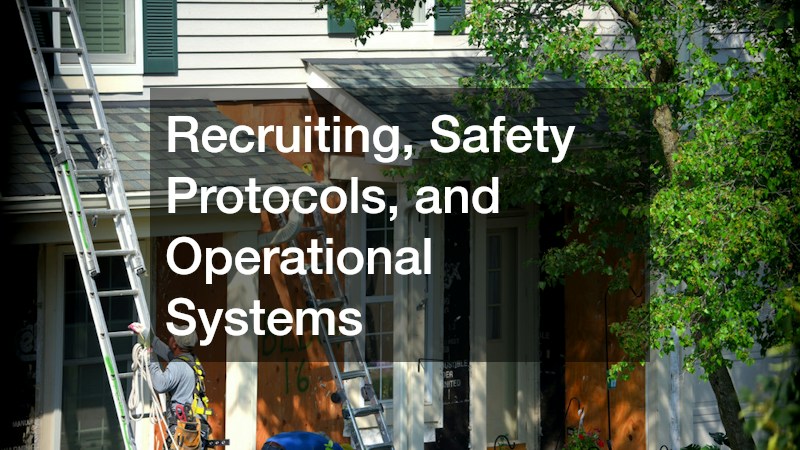
As your business grows, your primary role shifts from managing jobs to managing people and systems. The ultimate ceiling to scaling any trade business is human capital. Building a reliable, professional workforce requires creating a strong company culture, offering competitive compensation, and enforcing strict safety protocols.
Workplace safety must be embedded into your corporate culture from day one. Fall protection violations consistently top OSHA’s list of most frequently cited trade hazards, carrying massive regulatory fines and life-altering injury risks. Enforce a mandatory 100% tie-off policy for all work above six feet. Conduct weekly tailgate safety meetings, inspect harnesses and lanyards daily, and immediately terminate workers who bypass mandatory safety lines.
Recruiting top-tier talent in a competitive market requires offering clear career progression. Build a structured apprenticeship and training pipeline where motivated ground crew members can advance to lead installers, crew foremen, and project estimators. Offering competitive hourly wages, performance bonuses, health benefits, and paid time off attracts career-minded professionals who take pride in their work.
Systemize your daily field operations through cloud-based contractor management software. Modern platforms unify customer relationship management (CRM), job scheduling, aerial estimation, material ordering, field photo documentation, crew dispatching, and invoicing into a single digital workflow. Require foremen to upload time-stamped job-site photos at key installation phases—deck inspection, underlayment, flashing, and final cleanup—to verify installation quality remotely.
Superior customer service and site cleanliness are powerful brand differentiators. Out-execute unorganized local roofing companies by enforcing strict job-site etiquette: mandate property protection tarps over landscaping and decks, enforce magnetic nail sweeps across driveways and lawns, and conduct a final joint walkthrough with the property owner before collecting final payment.
- Enforce zero-tolerance fall protection policies: Require 100% tie-off compliance, daily harness checks, and weekly safety briefings.
- Create clear career growth pathways: Build structured training pipelines to advance ground workers into foremen and estimators.
Commit to making the strategic pivot today. Move beyond the daily grind of field labor and focus your energy on building repeatable operational systems, mentoring your team, and serving your community. As you put structured processes and dedicated personnel in place, you will build a highly profitable, respected company built to thrive for generations to come.